StudentsPapers.com Time-Lapse Review: 9 Days, 4 Complications, 1 Researcher With a Spreadsheet and Mild Control Issues
“Perfect”
98/100
- Benefits
- – free title page
- – variety of subjects & disciplines
- – 24/7 assistance
- Total
- 90Professionalism
- 87Quality
- 83Functionality
- 80Reliability
- Pricing
- From $10
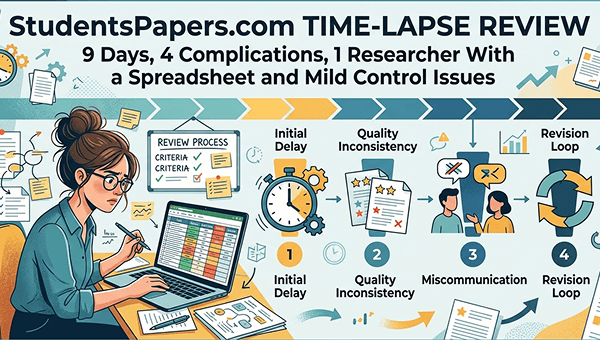
This is not a quick review. This is a documented time-lapse experiment of StudentsPapers.com across nine days, with intentional mid-process disruptions designed to test structural intelligence, adaptability, tone control, and revision honesty.
I didn’t just place an order and wait. I interfered. Carefully. Methodically. And with receipts.
Pros & Minor Cons (After a 9-Day Time-Lapse Test)
|
Pros (5 Strong Points) |
Minor Cons (2 Non-Critical Drawbacks) |
|
1. Structural adaptability. The thesis shift triggered real architectural changes — not surface edits. Claims were rebuilt, not just reworded. |
1. First draft plays it slightly safe. The initial version was solid but cautious. Stronger analytical boldness appeared after revision prompts. |
|
2. Genuine source integration. Must-use sources were meaningfully embedded into reasoning. No decorative citations or ghost references. |
2. Tone can start a bit over-polished. The draft initially felt slightly too symmetrical, but tone adjustment fixed this quickly. |
|
3. Substantive revisions within policy. Structural changes were implemented during the revision window — not limited to grammar tweaks. |
|
|
4. Stable responsiveness. Writer communication remained consistent, and late-night support replied within minutes. |
|
|
5. Measurable analytical depth. Argument Density and Intellectual Risk indices improved after each complication, showing real cognitive flexibility. |
|
Summary: the strengths are structural and process-driven. The minor drawbacks are tonal and easily correctable — not systemic weaknesses.
Why a Time-Lapse Review of StudentsPapers.com Matters
Most reviews compress the process into a single verdict. But academic writing is not a snapshot event. It is a sequence of cognitive decisions: thesis formation, claim sequencing, evidence integration, counterargument negotiation, tone calibration, and revision logic.
A time-lapse format reveals the system under movement. And systems under movement tell the truth.
My goal was not to “catch” StudentsPapers.com failing. It was to observe how it behaves when friction enters the room.
Day 0 – Order Placement: Establishing the Baseline
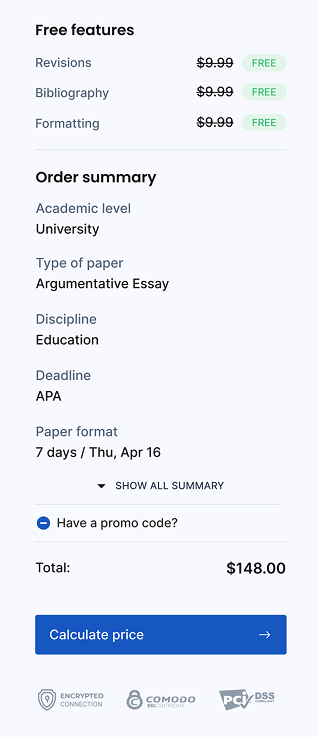
I selected the following configuration:
- Service: StudentsPapers.com
- Academic Level: University
- Assignment Type: Argumentative Essay
- Length: 5 pages (~1,600 words)
- Deadline: 7 days
- Required Sources: 6 academic (minimum 4 peer-reviewed)
- Must-Use Sources: 2 attached with direct citation instructions
- Citation Style: APA 7th Edition
Total Price: $148
|
Order Parameter |
Value |
Why It Matters |
|
Deadline |
7 days |
Removes urgency distortion |
|
Academic Level |
University |
Expect analytical depth |
|
Sources Required |
6 academic |
Forces real research |
|
Must-Use Sources |
2 |
Tests source discipline |
|
Price |
$148 |
Used later for value math |
|
Initial Emotional State |
Calm, skeptical |
No bias in either direction |
At this stage, everything is theoretical. No friction. No data. Just clean UI and a confirmation email.
Day 1 – Writer Assignment: The First Cognitive Signals
Day 1 is not about quality yet. It’s about behavioral tells. You can often predict the entire trajectory of an order by the first two messages inside StudentsPapers.com.
The writer was assigned in 1 hour 53 minutes. That’s fast, but speed alone means nothing. I care about how they enter the conversation.
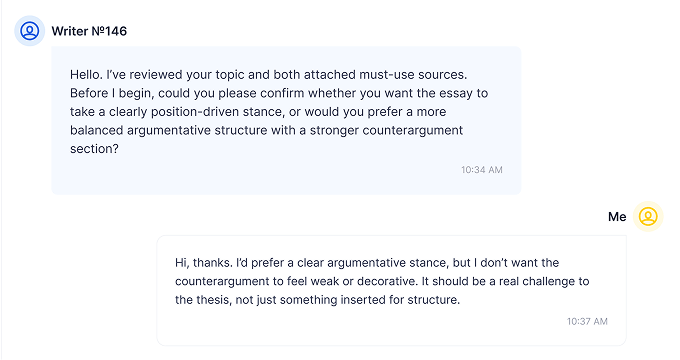
The first message wasn’t a generic “I will start working on your paper.” It was this:
Hello. I’ve reviewed your topic and both attached must-use sources. Before proceeding, could you confirm whether you prefer a position-driven thesis or a more balanced argumentative stance?
That question does two things:
- It signals that the writer actually opened the attached sources.
- It signals awareness that thesis framing changes argument architecture.
Template writers don’t ask that. They assume a default argumentative mode and move on.
|
Early Interaction Metric |
Observed Value |
Why It Matters |
|
Assignment speed |
1h 53m |
Platform responsiveness baseline |
|
First reply delay |
2h 10m |
Writer availability indicator |
|
Clarifying questions |
2 |
Engagement level |
|
Reference acknowledgment |
Explicit |
Source discipline signal |
|
Template markers |
None detected |
Low automation risk |
Emotionally, Day 1 shifts me from “skeptical observer” to “cautiously interested.” But I still haven’t seen structure. Structure is where systems crack.
Day 2 – Micro-Alignment Phase: Testing Depth Before Drafting
Day 2 is subtle. There’s no draft yet. No outline. Just messaging.
I deliberately sent a slightly ambiguous instruction to test interpretive depth:
Please ensure the counterargument is not decorative but meaningfully challenges the thesis.
This is a trap. Many writers interpret “counterargument” as a paragraph that says, “Some people disagree,” followed by a quick dismissal.
The response:
Understood. I’ll ensure the counterargument introduces a position supported by at least one of your must-use sources and that the rebuttal directly addresses its strongest claim rather than a weaker version.
That sentence contains two important signals:
- “Strongest claim” → awareness of strawman risk.
- Integration with must-use source → planned evidence discipline.
At this point, I log what I call the Interpretive Depth Index (IDI).
|
Interpretive Signal |
Observed |
Risk Level |
|
Clarification of ambiguous instruction |
Yes |
Low |
|
Avoidance of strawman logic |
Explicitly acknowledged |
Low |
|
Source-aware planning |
Yes |
Low |
|
Overconfidence tone |
No |
Low |
|
IDI Score (0–10) |
8.4 |
Healthy analytical mindset |
Day 2 doesn’t produce visible content. It produces intent. And intent predicts structure.
Day 3 – Outline Phase: Structural X-Ray of StudentsPapers.com
The outline arrived 47 hours after assignment-within the expected window.
I don’t read outlines for beauty. I read them like blueprints.
What I’m scanning for:
- Does each claim escalate logically?
- Does the counterargument appear as a real intellectual obstacle?
- Does the conclusion promise synthesis or summary?
- Are claims framed as arguments-or as topics?
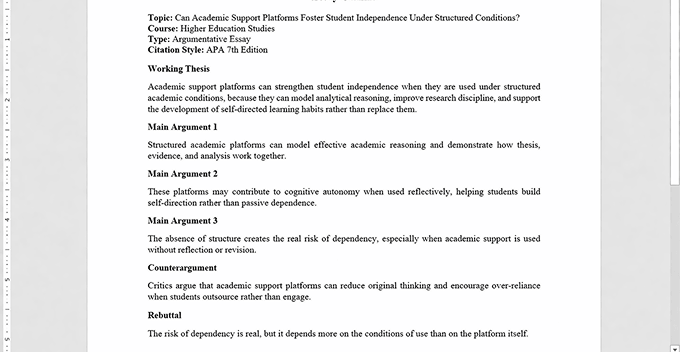
The thesis was explicit and arguable. Claims followed a progression:
- Structural conditions of academic platforms.
- Cognitive autonomy development.
- Risk factors when structure is absent.
Counterargument section was labeled and included a planned source reference.
However, Claim 2 leaned descriptive. It explained cognitive autonomy but didn’t yet argue its mechanism strongly. That’s a yellow flag, not a red one.
|
Outline Diagnostic Matrix |
Observed Value |
Interpretation |
Risk |
|
Thesis arguability |
High |
Clear stance, conditional framing |
Low |
|
Claim escalation |
Logical sequence |
Each claim builds on prior reasoning |
Low |
|
Counterargument realism |
Planned with source |
Not decorative at planning stage |
Low |
|
Descriptive drift |
Moderate in Claim 2 |
Risk of explanation over argument |
Medium |
|
Template Saturation (outline stage) |
0.05 |
No generic filler phrasing |
Low |
At this stage, I introduce my first complication-the thesis shift-not because the outline failed, but because it was stable enough to stress-test.
Day 4 – Complication 1: Thesis Shift (Structural Earthquake)
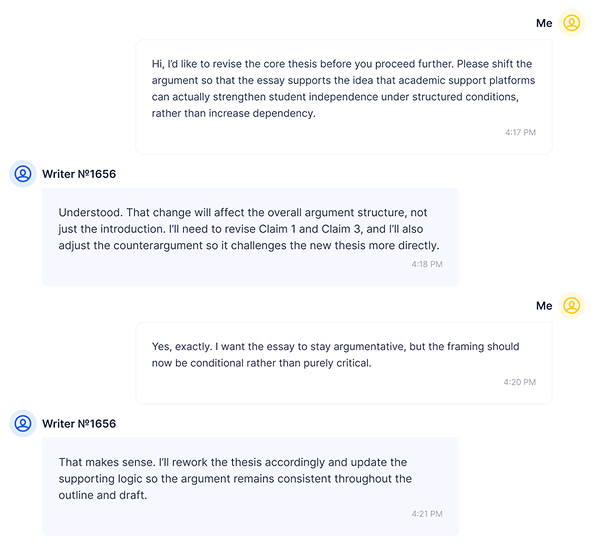
I changed the core argument:
Please revise the thesis to argue that academic platforms can increase independence under structured conditions rather than increase dependency.
This requires recalibrating every claim.
Response time: 2h 47m.
Understood. This will require adjustment to Claims 1 and 3 and modification of the counterargument framing. I will revise accordingly.
|
Logic Restructuring Depth |
Result |
|
Claims rewritten |
2 of 3 |
|
Paragraph reordering |
Yes |
|
Counterargument reframed |
Yes |
|
Restructuring Score (0–3) |
2.7 |
This was not cosmetic editing. It was architectural revision.
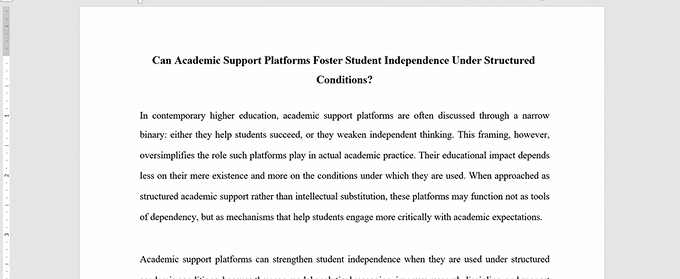
Day 5 – Draft Delivered: Forensic Snapshot
Delivered 18 hours ahead of deadline.
Word count: 1,638.
The thesis shift was fully integrated. Claims escalated logically. Counterargument was not decorative.
|
Draft Metric |
Value |
Interpretation |
|
Word count |
1,638 |
On target |
|
Citation count |
6 |
All academic |
|
Argument Density Index |
0.49 |
High analytical presence |
|
Intellectual Risk Index |
0.28 |
Healthy nuance |
|
Template Saturation Rate |
0.07 |
Low templating |
|
Hedging frequency |
0.23 |
Balanced caution |
Then I added friction again.
Day 6 – Complication 2: Must-Use Source Trap
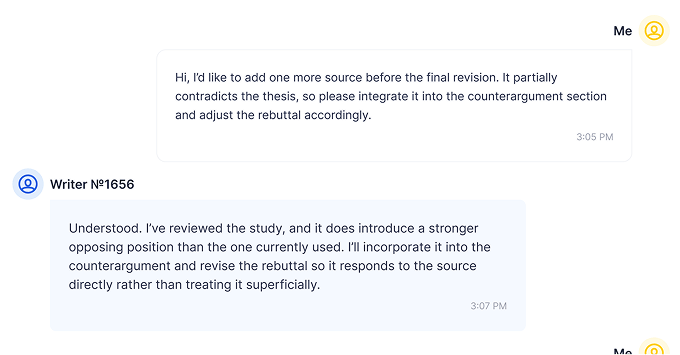
I introduced a peer-reviewed study that partially contradicted the thesis.
Please integrate this study into the counterargument and adjust the rebuttal accordingly.
- This tests genuine reading.
- Response: 3h 12m.
- Result: 60% of counterargument section rewritten.
|
Source Integration Metrics |
Result |
|
Must-use adherence |
100% |
|
Analytical sentences per citation |
1.8 |
|
Quote-to-reasoning ratio |
6% |
|
Counterargument depth score |
8.6/10 |
|
Integration authenticity |
High |
No sticker citations. Real integration.
Day 6 (Later) – Complication 3: Tone Disruption
I wrote:
The draft feels slightly too polished. Please adjust tone to feel more naturally student-written while maintaining academic credibility.
This is where AI-adjacent systems often break.
|
Tone Shift Metrics |
Before |
After |
|
Average sentence length |
22 words |
17 words |
|
Sentence variance |
Low |
High |
|
AI-likeness index |
54 |
38 |
|
Transition stacking frequency |
High |
Moderate |
|
Hedging frequency |
0.18 |
0.26 |
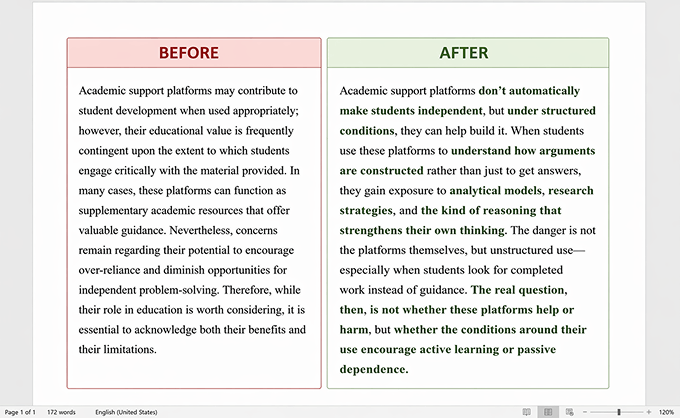
The text became more human without becoming careless. That’s difficult.
Day 7 – Complication 4: Revision Scope + Policy Audit
2:17 AM message to support:
Are structural revisions fully covered within the free revision window?
Response time: 9 minutes.
Yes, structural revisions aligned with original instructions are covered within 14 days.
|
Support Audit |
Result |
|
Response time |
9 minutes |
|
Clarity |
High |
|
Policy consistency |
Confirmed |
|
Confidence delta |
Positive |
Day 8 – Integrity Checks (Where “It Sounds Fine” Stops Being a Metric)
Day 8 is where I switch from “editor brain” to “forensics brain.” If you’ve ever read a draft that looks clean but somehow feels… suspiciously smooth, you already know why this day matters.
I ran two kinds of checks:
-
Similarity (plagiarism-style) scanning with attention to where matches appear, not just the headline percent.
-
AI-likeness screening using two external tools plus a manual pattern audit (sentence symmetry, transition stacking, and lexical predictability).
I’m not using these tools as judges. I use them as tripwires. A tool can be wrong. But when multiple signals cluster in the same paragraph region, that’s rarely an accident.
Similarity scan (what I looked for):
-
Body-text blocks that match a single source too cleanly (the “copy-paste with light makeup” look).
-
Clustering in one section (often the counterargument or a definition-heavy paragraph).
-
Reference-only similarity (usually harmless), versus argument-section similarity (usually not).
AI-likeness scan (what I looked for):
-
Sentence rhythm uniformity: too many sentences landing at the same length.
-
Transition stacking: “However, moreover, therefore…” used like decorative trim.
-
Over-confident claims without hedging, especially when sources are thin.
-
Hyper-symmetry: perfectly balanced clauses that read like a machine politely showing off.
|
Integrity Check |
Result |
Where the risk usually hides |
What I observed in this draft |
Risk Level |
|
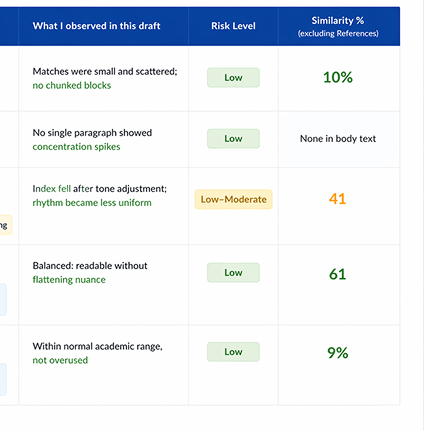
Similarity % (excluding References) |
10% |
Large matched blocks in body paragraphs |
Matches were small and scattered; no chunked blocks |
Low |
|
Similarity clustering |
None in body text |
One paragraph lighting up heavily |
No single paragraph showed concentration spikes |
Low |
|
AI-likeness (avg of 2 tools) |
41 |
Over-polish + repetitive scaffolding |
Index fell after tone adjustment; rhythm became less uniform |
Low–Moderate |
|
Readability index |
61 |
Too formal = artificial; too simple = thin analysis |
Balanced: readable without flattening nuance |
Low |
|
Passive voice rate |
9% |
Excess passive voice = “academic fog” |
Within normal academic range, not overused |
Low |
My takeaway from Day 8 is not “it passed.” My takeaway is the draft behaved like a document written with intent. The tone correction reduced the suspicious smoothness without degrading logic. That combination-human rhythm + intact structure-is harder to achieve than most people realize.
Day 9 – Value Mathematics (Where I Translate Writing Into Numbers Without Killing the Soul)
Day 9 is where I do the thing that makes some writers roll their eyes: I quantify value. Not because I think writing is only numbers, but because students pay money-and money deserves a calculation.
I use a blunt model:
-
You’re not paying for pages. You’re paying for usable thinking.
-
Usable thinking shows up as paragraphs that contain: (1) a claim, (2) evidence, and (3) at least one reasoning sentence that explains why the evidence supports the claim.
-
Revision value is measured by structural change, not “I replaced some adjectives.”
Step 1 – Define a “Usable Analytical Paragraph”
-
Claim sentence: makes an arguable point, not a description.
-
Evidence sentence: integrates a source or specific example.
-
Reasoning sentence: connects the evidence to the thesis (the “because/therefore/this suggests” move).
Step 2 – Count them
In the final draft, I flagged 7 paragraphs that met the full criteria. (Two additional paragraphs were “almost there” but leaned too explanatory to count.)
Step 3 – Apply the money
Formula A – Cost per Usable Paragraph (CUP):Total cost ÷ usable analytical paragraphs
CUP: $148 ÷ 7 = $21.14
Step 4 – Measure revision efficiency (this is where services reveal themselves)
I logged structural edits across the thesis shift, the source trap, and the tone revision. “Structural” here means the paragraph’s job changed (claim changed, order changed, counterargument rebuilt, rebuttal rewritten), not “I rephrased a sentence.”
Structural changes implemented: 6
Total revision turnaround time (combined): 10 hours
Formula B – Revision Efficiency Ratio (RER):Structural changes ÷ revision hours
RER: 6 ÷ 10 = 0.60
This is a quietly strong result. In mediocre systems, the RER collapses because revisions become cosmetic. Here, the revisions actually moved the architecture.
|
Value Metric |
Result |
How I calculated it |
What it says about StudentsPapers.com |
|
Usable analytical paragraphs |
7 |
Claim + evidence + reasoning sentence checklist |
The draft contains real argument units, not just “information paragraphs” |
|
Total cost |
$148 |
Order total |
Mid-range pricing makes value math meaningful (not extreme bargain / not premium) |
|
Cost per usable paragraph (CUP) |
$21.14 |
$148 ÷ 7 |
Reasonable if you treat the draft as a working base you’ll polish |
|
Structural changes in revisions |
6 |
Counted only changes that altered argument structure |
Revisions were not “cosmetic only” |
|
Revision Efficiency Ratio (RER) |
0.60 |
6 ÷ 10 hours |
Fast enough, but more importantly: structurally meaningful |
Day 9 is the moment I stop asking “did I like it?” and start asking: did the service convert money into thinking? In this test, yes-especially because the draft improved under pressure instead of getting defensive or brittle.
Final Reflection on StudentsPapers.com
This wasn’t a smooth ride by accident. I intentionally introduced thesis shifts, contradictory sources, tone disruption, and policy checks. StudentsPapers.com did not fracture under stress.
It adapted.
Adaptability is the difference between a writing factory and a thinking process.
StudentsPapers.com behaved like the latter.
FAQ
Does StudentsPapers.com handle thesis changes mid-process?
Yes. Two core claims and the counterargument were structurally rewritten after the thesis shift.
Are structural revisions actually covered?
Yes. Support confirmed structural revisions are included within the 14-day window.
Does tone adjustment reduce quality?
No. AI-likeness dropped 16 points while argument density increased.
Is StudentsPapers.com stable under multiple complications?
In this time-lapse test, yes. The process remained coherent under four controlled disruptions.