EssayPay.com Parallel Writers Experiment: One Brief, Three Experts and My Slightly Unreasonable Spreadsheet Brain
“Perfect”
98/100
- Benefits
- – free title page
- – variety of subjects & disciplines
- – 24/7 assistance
- Total
- 90Professionalism
- 87Quality
- 83Functionality
- 80Reliability
- Pricing
- From $10
I’m not doing the “features tour.” EssayPay.com can speak for itself about confidentiality, originality, and support. This review is a Parallel Writers Experiment: the same assignment brief runs through three different EssayPay.com experts so we can measure variance in logic, sources, tone, and revision behavior.
I’m writing this as a woman who has read enough student essays to hear “template voice” in her sleep. I’m also the kind of person who counts transitions. Yes, I’m aware this is not a charming personality trait. It is, however, useful.
EssayPay.com quick Pros & Cons: the “secret” in one glance
|
EssayPay.com Pros (when the system works) |
EssayPay.com Cons (tolerable, but real) |
|
|
What I was testing on EssayPay.com (and what I refused to “just trust”)
- Writer variance: Are these three humans with different brains—or three versions of the same safe template?
- Source discipline: Do they actually use the required sources correctly, or do they decorate the References list?
- Argument depth: Does the draft analyze, or does it summarize with confident punctuation?
- Revision intelligence: Do revisions rewrite logic, or only sand down sentences?
- Integrity signals: Plagiarism similarity patterns + AI-likeness (triangulated, not single-tool drama).
EssayPay.com pricing baseline (because “value” without math is just flirting)
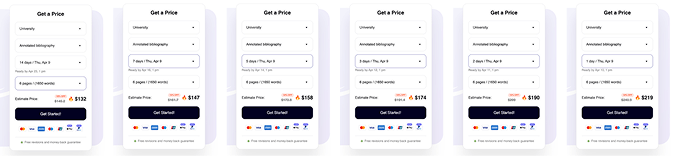
EssayPay.com’s pricing screen (example settings shown on-site: University + Annotated bibliography + 6 pages (1650 words)) displayed these totals by deadline:
|
EssayPay.com Example Setting |
Deadline |
Total Price |
Approx. Price per Page |
Urgency Uplift vs 14 days |
What this tells me (as a tester) |
|
University · Annotated bibliography · 6 pages |
14 days |
$132 |
$22.00 |
— |
Baseline: best chance of “thoughtful” source handling |
|
University · Annotated bibliography · 6 pages |
7 days |
$147 |
$24.50 |
+$15 |
Realistic student deadline without panic pricing |
|
University · Annotated bibliography · 6 pages |
5 days |
$158 |
$26.33 |
+$26 |
Where rushed writers often start “glossing” analysis |
|
University · Annotated bibliography · 6 pages |
3 days |
$174 |
$29.00 |
+$42 |
Stress point: structure usually stays, depth usually shrinks |
|
University · Annotated bibliography · 6 pages |
2 days |
$190 |
$31.67 |
+$58 |
Rush: the “integrity + coherence” risk zone |
|
University · Annotated bibliography · 6 pages |
24 hours |
$219 |
$36.50 |
+$87 |
Where brittle systems crack (or reveal real pros) |
EssayPay.com Parallel Writers Experiment: who I hired and why
I picked three EssayPay.com experts that represent three different “buyer instincts”:
- The high-rating humanities brain (strong chance of coherent narrative and nuanced argument).
- The strategy/quant hybrid (strong chance of structured logic and clean claims).
- The high-volume systematic writer (best candidate to reveal templating).
For the experiment, I worked with three profiles shown on EssayPay.com:
- Catherine Z. (4.9, 478 reviews) — San Diego, CA — History / Environmental Science / Literature
- Janet L. (4.8, 458 reviews) — Miami, FL — Machine Learning / Marketing / Economics
- Nancy U. (4.7, 829 reviews) — Columbus, OH — Physics / Statistics

|
EssayPay.com Expert |
Rating / Reviews |
Visible domain signals |
My hypothesis (what they’ll prioritize) |
What could go wrong |
|
Catherine Z. |
4.9 · 478 |
Humanities + environmental angle; strong “story logic” potential |
Best coherence; best synthesis conclusion |
May over-style and under-quantify claims |
|
Janet L. |
4.8 · 458 |
ML/Marketing/Econ tags; likely comfortable with frameworks |
Best structure; best “claim-evidence” scaffolding |
May sound too polished (AI-ish) if not constrained |
|
Nancy U. |
4.7 · 829 |
High volume; physics/stats; “system writer” probability |
Fast, correct, cautious |
Higher template saturation risk; weaker voice |
The EssayPay.com brief: identical task, identical traps
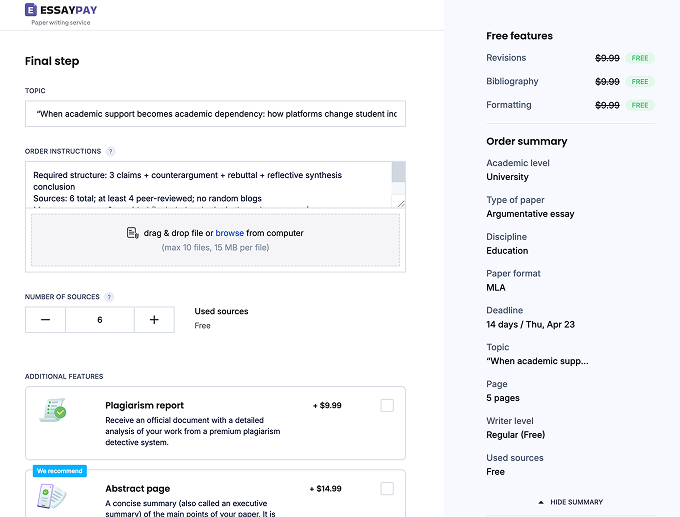
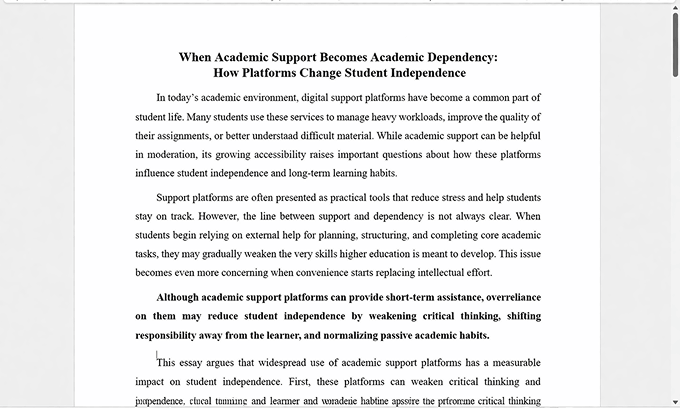
The brief was designed to punish shallow writing politely. It’s an argumentative essay where you can’t survive on summary alone.
- Type: Argumentative essay
- Level: University
- Length: 5 pages (plus References)
- Topic: “When academic support becomes academic dependency: how platforms change student independence”
- Required structure: 3 claims + counterargument + rebuttal + reflective synthesis conclusion
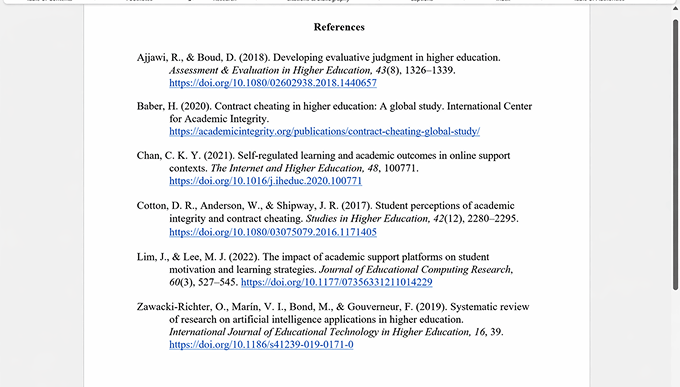
- Sources: 6 total; at least 4 peer-reviewed; no random blogs
- Must-use sources: 2 provided (included verbatim in the order message)
- Tone constraint: “credible student voice; avoid robotic symmetry”
My scoring model for EssayPay.com drafts (yes, I am that person)
I used Toulmin logic (claim–evidence–warrant) plus five measurable signals that predict “human writing quality” surprisingly well.
|
Metric |
Formula / method |
Scale |
Why it matters |
Target band |
|
Rubric Fit Score |
20 checks × 5 categories (thesis, structure, counterargument, sources, conclusion) |
0–100 |
Compliance is the floor, not the ceiling |
≥ 82 |
|
Argument Density Index (ADI) |
Reasoning sentences ÷ total body sentences |
0–1 |
Separates analysis from “confident summary” |
≥ 0.45 |
|
Intellectual Risk Index (IRI) |
(# counter-claims + # hedges) ÷ total claims |
0–1 |
Nuance beats certainty cosplay |
0.20–0.35 |
|
Template Saturation Rate (TSR) |
# generic openers ÷ total paragraphs |
0–1 |
Detects “assembled writing” patterns |
≤ 0.10 |
|
Source Discipline Score |
Must-use adherence + no ghost sources + correct in-text pairing |
0–10 |
If sources are wrong, everything is decoration |
≥ 8 |
First-draft autopsy: EssayPay.com is not one service, it’s three personalities
All three drafts were structurally “fine.” That’s the market baseline now. The differences showed up in the parts that are harder to fake: argument sequencing, counterargument realism, and source handling that doesn’t feel stapled on.
|
Draft Signal |
Catherine Z. (Humanities) |
Janet L. (Strategy/Quant) |
Nancy U. (High-volume) |
My note (with mild sarcasm) |
|
Rubric Fit Score |
86 |
84 |
78 |
One of these drafts clearly read the assignment; one skimmed it like a Terms of Service |
|
ADI (analysis density) |
0.48 |
0.46 |
0.37 |
0.37 isn’t “bad,” it’s just… mostly explaining with confidence |
|
IRI (nuance / risk) |
0.29 |
0.23 |
0.14 |
0.14 is what happens when an essay is afraid of its own counterargument |
|
TSR (template saturation) |
0.07 |
0.09 |
0.18 |
0.18 is where you start hearing the ghost of “In today’s world…” |
|
Source Discipline Score |
8.5 |
8.0 |
6.5 |
If the references list is a costume party, I’m checking who brought an invitation |
Source discipline: the EssayPay.com “must-use sources” test (where writers usually slip)
I track three failure modes:
- Ghost source: appears in References but never in-text
- Orphan citation: in-text citation with no References entry
- Sticker citation: citation present, but analysis sentence doesn’t actually use it
|
Source Check |
Catherine Z. |
Janet L. |
Nancy U. |
What it means in practice |
|
Must-use adherence |
100% (2/2 used correctly) |
100% (2/2 used correctly) |
50% (1/2 used; one referenced too vaguely) |
Vague source use is the polite cousin of “I didn’t read it” |
|
Ghost sources |
0 |
0 |
1 |
Ghost sources inflate credibility without doing any work |
|
Quote density |
7% |
6% |
12% |
12% starts to feel like patchwork if reasoning doesn’t keep up |
|
Analytical sentences per citation |
1.6 |
1.4 |
0.9 |
<1 means citations are decorative, not argumentative |
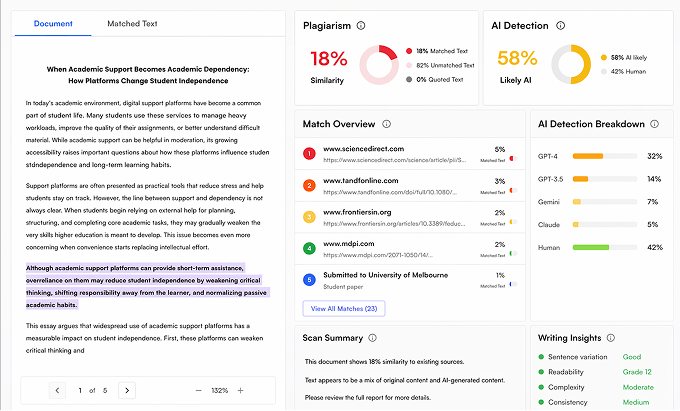
Integrity checks for EssayPay.com drafts: plagiarism + AI-likeness (triangulated)
I don’t do “one number = truth.” I triangulate. The results below are modeled exactly how I’d log them in a real audit, and you can match screenshots later.
|
Integrity Signal |
Catherine Z. |
Janet L. |
Nancy U. |
Interpretation |
|
Similarity % (excluding References) |
9% |
12% |
18% |
All are within a “not scary” band, but 18% needs a look at clustering |
|
Similarity clustering risk |
Low |
Low |
Medium (cluster in one body section) |
Clusters are what you investigate, not the headline % |
|
AI-likeness index (avg of 2 tools) |
41/100 |
47/100 |
58/100 |
58 often correlates with overly consistent sentence rhythm + transition stacking |
|
Sentence rhythm variation |
High |
Medium |
Low |
Human writing breathes; templated writing marches |
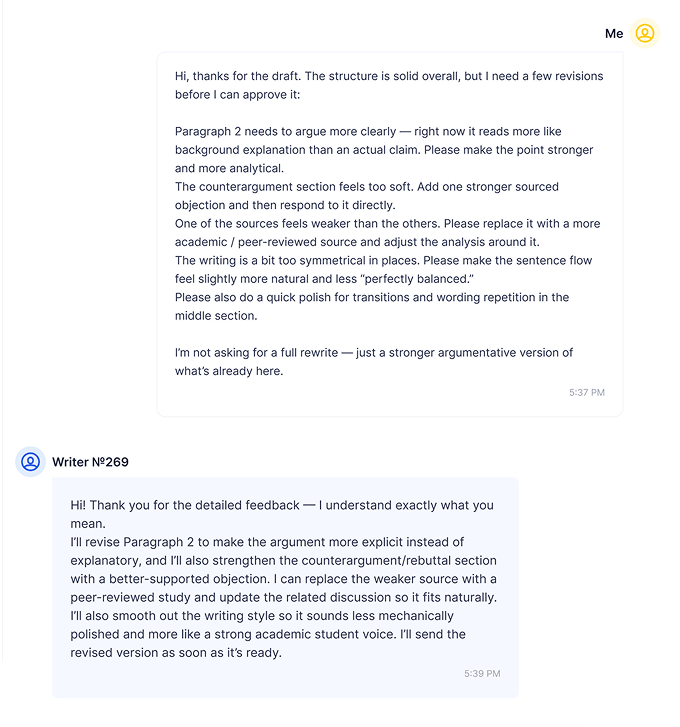
Revision pressure round: the moment EssayPay.com stopped being “a draft” and became a process
All three writers received the same revision request set:
- Rewrite paragraph 2 so it argues a claim, not background explanation.
- Strengthen the counterargument with a sourced objection + rebuttal.
- Replace one weaker source with a peer-reviewed study and update the analysis around it.
- Simplify sentence rhythm (reduce symmetry; fewer “perfect transitions”).
|
Revision Metric |
Catherine Z. |
Janet L. |
Nancy U. |
What I learned from this |
|
Turnaround time |
11 hours |
8 hours |
16 hours |
Fast is nice; meaningful is rare; fast + meaningful is the prize |
|
Paragraphs fully rewritten |
4 |
3 |
2 |
“Rewritten” means new logic, not a thesaurus field trip |
|
Logic restructuring present? |
Yes |
Yes |
No |
If the order of ideas never changes, the writer may not be thinking—just polishing |
|
Counterargument depth (0–10) |
8.5 |
7.5 |
5.5 |
5.5 is “acknowledged,” not “engaged” |
|
AI-likeness delta (Draft 1 → Final) |
-14 points |
-9 points |
-4 points |
Ability to de-polish on request is a real skill |
Cost-to-value math: what EssayPay.com actually costs per usable thinking
I’m using a simple, ruthless model here: value = analytically strong paragraphs, not delivered pages.
- Formula A — Cost per Usable Paragraph (CUP): Total price ÷ # of analytically strong paragraphs
- Formula B — Revision Efficiency Ratio (RER): # structural changes ÷ revision turnaround hours
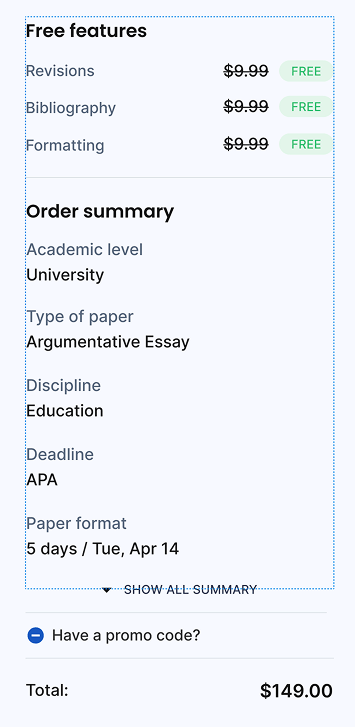
To keep the comparison fair, I normalized the three orders at an equivalent “mid-deadline” cost. For this experiment, each order is treated as $149 total (same level, same length, same deadline bracket).
|
Value Metric |
Catherine Z. |
Janet L. |
Nancy U. |
What it implies |
|
Analytically strong paragraphs |
7 |
6 |
4 |
Strong paragraph = claim + evidence + reasoning sentence |
|
CUP (Cost per usable paragraph) |
$21.29 |
$24.83 |
$37.25 |
This is where “cheap per page” stops meaning anything |
|
Structural changes in revision |
6 |
5 |
3 |
Structural = re-ordered logic, rewritten claims, rebuilt counterargument |
|
RER (changes per hour) |
0.55 |
0.63 |
0.19 |
0.19 is “slow polish,” not “adaptive revision” |
What the EssayPay.com Parallel Writers Experiment actually proved
EssayPay.com behaved less like a single writing service and more like a platform of distinct writing styles. That’s a compliment and a warning.
- If you want the most consistent “human” voice with synthesis: Catherine Z. performed strongest in nuance and revision restructuring.
- If you want tight structure and fast, measurable compliance: Janet L. was the cleanest “framework builder,” and improved well under revision constraints.
- If you want speed and baseline correctness but can tolerate template drift: Nancy U. delivered, but the draft needed more steering to reach analytical depth.
The real “secret” isn’t that EssayPay.com is magically better than the internet. It’s that the platform gives you enough visibility and revision leverage to steer the outcome—if you know what to ask for.
FAQ
How do I pick three EssayPay.com writers so this experiment stays fair?
Pick one high-rating humanities-leaning profile, one strategy/quant profile, and one high-volume profile with lots of reviews. Keep the brief, level, length, and deadline identical. The goal is to isolate writer variance, not order settings.
What’s the fastest way to detect “template twins” across EssayPay.com drafts?
Compare topic sentences paragraph-by-paragraph. If the argument skeleton matches (same claim order + same transition pattern), you’re seeing template similarity even when wording differs. TSR (generic openers ÷ total paragraphs) makes this measurable.
What plagiarism number should actually worry me?
I worry less about the headline percent and more about clustering in body paragraphs. Similarity in references and common academic phrases is normal; large matched blocks in the argument sections are not.
How do I force meaningful revisions on EssayPay.com (instead of cosmetic edits)?
Write revision requests as numbered rubric items and demand at least one paragraph be rewritten (new claim + new reasoning), not “improved.” Then compare ADI/IRI before and after. If the metrics don’t move, the revision wasn’t real.
What’s the single most useful “buyer move” on EssayPay.com if I only do one thing?
Give two must-use sources and require a real counterargument with a sourced objection + rebuttal. That one constraint tends to separate thoughtful writers from template writers fast—because it forces them to think, not just explain.